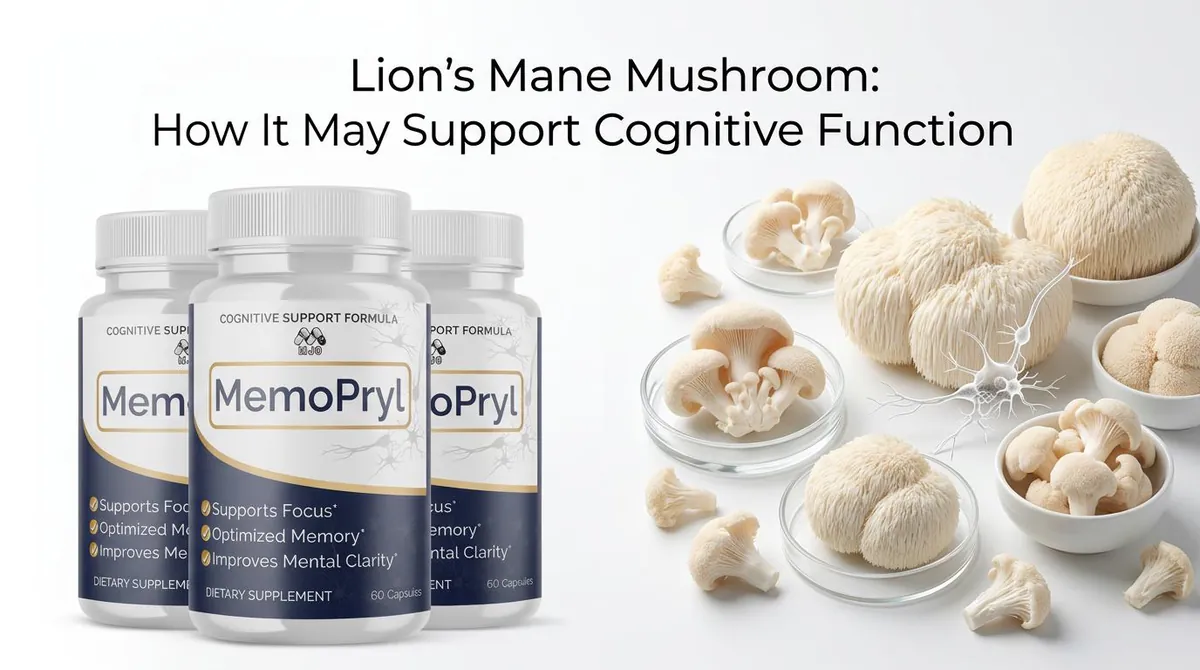
An Edible Mushroom With an Unusual Reputation
Lion's Mane grows naturally on hardwood trees throughout North America, Europe, and Asia. In China and Japan it has been used in traditional medicine and gourmet cooking for centuries. Its meaty texture has earned it nicknames like "the seafood of the forest." But what has made Lion's Mane stand out in modern research is not its culinary value — it's the unique pair of compounds it produces.
The Compounds Behind the Curiosity
Lion's Mane contains two families of bioactive compounds that researchers find especially interesting:
- Hericenones — found in the fruiting body (the part of the mushroom you see and eat).
- Erinacines — found mainly in the mycelium (the root-like network beneath the surface).
Both classes of compounds have been investigated in laboratory studies for their interaction with what scientists call nerve growth factor (NGF) — a protein that plays an important role in the growth, maintenance, and survival of nerve cells.
What Is Nerve Growth Factor, in Plain English?
Think of nerve growth factor as the "construction and repair budget" for your nerve cells. It helps young nerve cells mature, helps existing ones stay healthy, and supports the connections (synapses) that nerve cells use to talk to each other. Healthy NGF activity is something brain health researchers have been studying for decades.
What Researchers Have Investigated
Modern research on Lion's Mane spans several areas:
- Laboratory and animal studies investigating Lion's Mane compounds' interaction with NGF activity.
- Small human trials looking at Lion's Mane's potential role in supporting cognitive function in older adults.
- Research into Lion's Mane's possible support for mood and mental wellbeing.
- Studies on Lion's Mane and the body's response to oxidative stress.
It's important to be honest about the state of the science: while early human studies are intriguing, most are small and the field needs larger, longer-term trials. The FDA has not approved Lion's Mane as a treatment for any condition, and it should be viewed as a dietary supplement intended to support cognitive health in healthy adults — not as a remedy.
Why Lion's Mane Pairs So Well With Other Brain Botanicals
Many brain supplements rely on stimulants like caffeine to deliver an immediate but short-lived "feeling something" sensation. Lion's Mane works differently. Its potential cognitive effects appear to build slowly over weeks of consistent intake — similar to Bacopa Monnieri, the other star of the MemoPryl formula. This makes the two ingredients natural companions: Bacopa is studied for memory and learning, Lion's Mane for nerve cell health and clarity.
Layered onto these botanicals, MemoPryl also includes:
- Ginkgo Biloba for brain circulation support
- Phosphatidylserine for brain cell membrane health
- Rhodiola Rosea for mental fatigue support
- Omega-3 DHA as a foundational brain nutrient
MemoPryl: 9 Brain-Supporting Ingredients, Including Lion's Mane
One daily capsule with Lion's Mane, Bacopa, Ginkgo and more. Made in the USA. 60-day guarantee.
Check Availability & Pricing →How Lion's Mane Is Typically Used
Lion's Mane is available in many forms: as a fresh culinary mushroom, as a powdered extract, as capsules, and as tinctures. The form matters: a tea made from sautйed mushroom slices delivers a very different amount of active compounds than a standardized extract. Quality supplements use mushrooms grown on hardwood (the traditional substrate) and clearly state whether the extract is from the fruiting body, the mycelium, or both.
Doses in human research have varied widely, with most studies in the range of 500 mg to 3,000 mg per day of a standardized extract. As with most botanicals, consistent daily use over 8–12 weeks is the most commonly studied pattern.
Who May Benefit From Lion's Mane?
- Healthy adults who want a non-stimulant approach to supporting focus and mental clarity.
- Mental professionals or learners looking for long-term cognitive support.
- Older adults who want to support brain health as part of a broader healthy lifestyle.
- Anyone curious about food-as-supplement traditions from East Asia.
Safety and Considerations
Lion's Mane is generally considered safe and well-tolerated. Some people with mushroom allergies may react to it, so caution is warranted if you have known allergies. As always, consult your healthcare provider before starting any new supplement, particularly if you are pregnant, nursing, taking medication, or have a medical condition.
The Bottom Line
Lion's Mane Mushroom is one of the most genuinely interesting items on the modern brain-supplement shelf. Its unique compound profile, long history of use in East Asian traditions, and ongoing research interest have earned it a place in MemoPryl. Pair it with our other research-inspired ingredients, take it consistently, and combine it with sleep, movement, and a nutrient-dense diet — and you are giving your brain a thoughtful, layered foundation of support.
Try MemoPryl Today
Lion's Mane + 8 more brain-support ingredients in a single daily capsule.
See Packages →