Where the Word "Nootropic" Comes From
The term was coined in 1972 by a Romanian-born chemist named Corneliu Giurgea. He defined a nootropic as a substance that should: support memory and learning, support brain function under stress, protect brain cells, and have very low toxicity. The word combines the Greek nous (mind) and tropein (to turn or bend) — "mind-turners," in effect.
Synthetic vs. Natural Nootropics
Today the term "nootropic" gets applied broadly. Some are synthetic pharmaceutical compounds — used mainly in medical settings — that are not the focus of this article. The natural-nootropic category covers botanicals and nutrients with a long traditional use and growing research literature for cognitive support.
The Natural Nootropic Hall of Fame
Bacopa Monnieri
Ancient Ayurvedic herb extensively studied for memory and learning. Full Bacopa overview →
Lion's Mane Mushroom
Unique mushroom investigated for its interaction with nerve growth factor. Full Lion's Mane overview →
Ginkgo Biloba
One of the most-studied botanicals for cerebral circulation and cognitive support. Full Ginkgo overview →
Rhodiola Rosea
Traditional adaptogen with research interest for mental fatigue. Full Rhodiola overview →
Phosphatidylserine
Phospholipid that's a structural component of brain cell membranes. Full PS overview →
Omega-3 DHA
Essential fatty acid that's foundational to brain tissue structure. Full DHA overview →
Alpha-GPC
A choline source studied for its support of acetylcholine — the brain's key memory neurotransmitter.
L-Theanine
Amino acid from green tea, studied for supporting a calm-but-alert mental state.
What Natural Nootropics Are Not
They are not medicines. They do not treat, diagnose, or cure any condition. They are not magic pills that instantly transform cognition. They are dietary supplements that, when chosen well and used consistently, may support cognitive health in healthy adults — alongside, not instead of, the lifestyle foundations.
Why "Stacking" Makes Sense
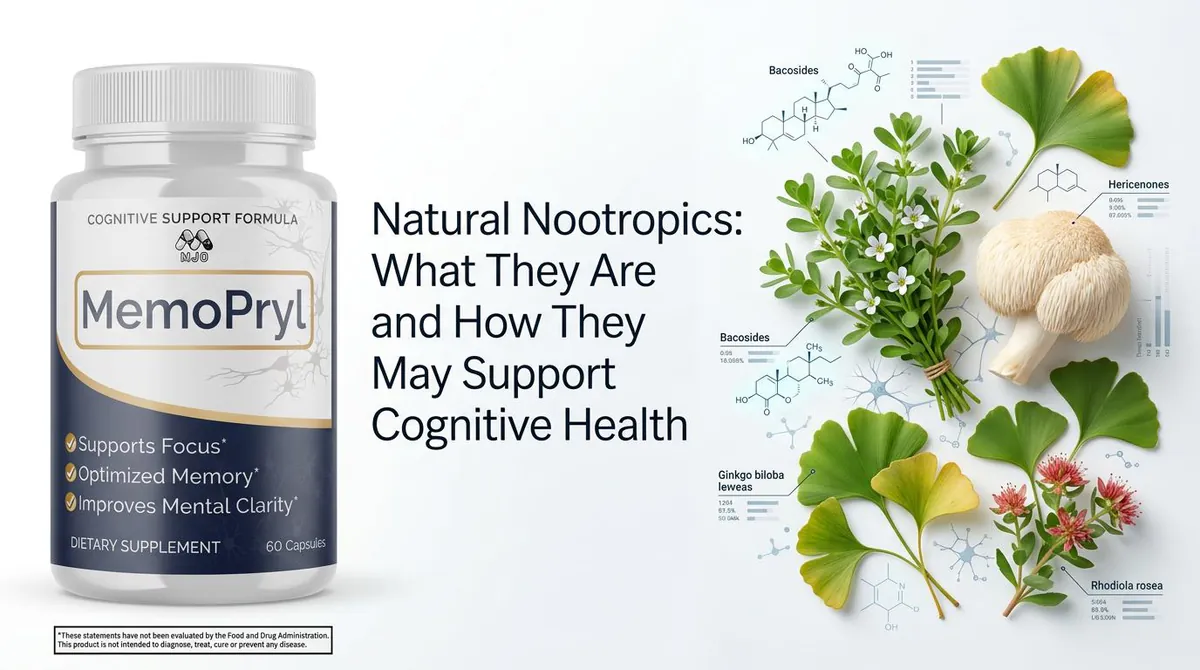
The brain is multifactorial. Memory, focus, energy, circulation, structure — these are different mechanisms. One ingredient rarely covers all of them. Well-formulated natural nootropic products "stack" several research-supported ingredients to provide layered support. MemoPryl is built on this principle: nine ingredients, each chosen for a distinct contribution.
MemoPryl: A Carefully Built Natural Nootropic Stack
Bacopa, Lion's Mane, Ginkgo, Phosphatidylserine, Rhodiola, Omega-3 DHA, Alpha-GPC, Lutein, and B vitamins — in one daily capsule.
Check Availability & Pricing →How to Evaluate a Natural Nootropic
- Check the ingredients. Are they real, traditional, research-supported?
- Check the doses. Are they in the range used in research?
- Check the manufacturing. FDA-registered, GMP-certified.
- Check the time horizon. Natural nootropics usually need 8–12 weeks.
- Check the company. Real contact info, real returns policy, real reviews.
See our brain supplement buyer's guide for a fuller checklist.
The Bottom Line
Natural nootropics aren't a shortcut. They are nutritional and botanical support layered onto a healthy lifestyle. Used well — consistent dosing, realistic expectations, careful product choice — they can be a meaningful addition to a brain-health routine. Used poorly, they are an expensive disappointment. MemoPryl was built for the first kind of user.